
The “retail apocalypse” narrative is a trap for average investors; for contrarians, it’s the single greatest opportunity for arbitrage by shifting from property ownership to active ecosystem engineering.
- Success now comes from creating synergistic commercial hubs, not just leasing space to e-commerce-resistant tenants.
- Predictive data (cell traffic, building permits) reveals a property’s true potential long before it’s reflected in market prices.
- Underperforming assets, particularly traditional office spaces, are the new frontier for creating value and driving traffic to adjacent retail.
Recommendation: To thrive, you must adopt the mindset of an “urban ecosystem engineer,” actively shaping the commercial environment rather than passively reacting to it.
The prevailing image of retail real estate is one of decline: empty storefronts, struggling malls, and the relentless march of e-commerce. Many investors, spooked by this narrative, have fled the sector. The common advice for those who remain is defensive—focus on “e-commerce proof” tenants like restaurants and gyms, or chase the broad, often ill-defined, trend of mixed-use development. These strategies are not wrong, but they are incomplete. They are reactions to a market shift that has already happened.
The real opportunity for the contrarian investor lies not in surviving the transition from product to experience, but in actively architecting it. But what if the key wasn’t simply finding better tenants, but in building an entire, data-verified ecosystem around them? What if the most valuable retail assets of tomorrow are born from the strategic repurposing of today’s underperforming office buildings? This approach requires a new mindset: that of an urban ecosystem engineer who leverages predictive data to identify and unlock value where others only see risk.
This guide moves beyond the platitudes of the retail renaissance. We will dissect the granular, data-driven strategies that visionary investors use to build resilient, high-yield portfolios. From the foundational stability of grocery-anchored centers to the art of using cell phone data to predict success, we will explore how to manufacture value, de-risk omnichannel leases, and even spot gentrification before it explodes. It’s time to stop reacting to the future of retail and start building it.
This article provides a comprehensive roadmap for the modern commercial real estate investor. The following sections break down the essential strategies, from foundational asset selection to advanced data analysis and asset repurposing.
Summary: A Contrarian’s Playbook for the New Retail Economy
- Why Grocery-Anchored Strips Are Recession-Resistant Assets?
- How to Use Cell Phone Data to Verify Foot Traffic Before Buying Retail?
- Pure Retail vs. Mixed-Use: Which Format Survives the “Retail Apocalypse”?
- The Percentage Rent Risk: What Happens When Your Tenant Shifts Sales Online?
- How to Revitalize a Strip Mall Facade to Increase Rents by 20%?
- How to Pivot Traditional Office Space into Medical or Lab Suites?
- How to Spot Gentrification Signs Before Property Prices Explode?
- Commercial Office Spaces: Is the ‘Death of the Office’ Narrative a Myth?
Why Grocery-Anchored Strips Are Recession-Resistant Assets?
In a volatile market, the cornerstone of any resilient retail portfolio is the grocery-anchored shopping center. These properties are not merely collections of stores; they are essential community hubs that thrive on non-discretionary spending. Unlike fashion or electronics, the demand for groceries is constant, creating a consistent and reliable flow of foot traffic that benefits all surrounding tenants. This inherent stability makes them a uniquely defensive asset class during economic downturns, a fact borne out by their historical performance.
The market recognizes this resilience. According to JLL’s latest grocery investment report, there was $7.0 billion in multi-tenant grocery-anchored retail transactions in 2024, showing robust investor appetite. This is not just about having any grocer. The quality of the anchor is paramount. A modern grocer acts as a destination, offering experiential elements like in-store dining, cooking classes, or wine bars that increase “dwell time” and create a stickier customer base. This, in turn, supports a vibrant co-tenant ecosystem of daily-need services like boutique fitness studios, health clinics, and fast-casual restaurants.
Case Study: The Phillips Edison & Company Portfolio
Phillips Edison & Company, a REIT specializing in grocery-anchored centers, provides a compelling example. Throughout 2024, they maintained an impressive 98% portfolio occupancy, demonstrating the power of focusing on essential retail. Their success hinges on securing long-term, triple-net leases with strong grocery anchors and curating a complementary mix of service-oriented tenants that are insulated from e-commerce pressures.
Furthermore, the strategic value of these locations has been amplified by the rise of omnichannel retail. Grocery stores have become critical last-mile logistics hubs, facilitating click-and-collect, curbside pickup, and third-party delivery services. This logistical function adds a new layer of value and revenue potential that traditional retail centers cannot match, solidifying their position as a superior long-term investment.
How to Use Cell Phone Data to Verify Foot Traffic Before Buying Retail?
The age-old real estate mantra of “location, location, location” has been upgraded. Today, it’s “data, data, data.” For the contrarian investor, gut feelings and anecdotal evidence are no longer sufficient. Verifying the true vitality of a retail center before acquisition is non-negotiable, and mobile phone data provides the ground truth that traditional due diligence often misses. This isn’t just about counting cars; it’s about understanding human behavior at a granular level.
By analyzing anonymized cell phone data, investors can move beyond simple visitor counts to uncover deep insights. Key metrics include customer dwell time (how long they stay), cross-visitation patterns (where they shop before and after), and detailed demographic profiles (age, income levels, lifestyle interests). This data allows you to validate a seller’s claims, identify the true trade area, and assess the health of the co-tenancy synergy. A high volume of traffic that only visits the anchor and leaves is a red flag; high dwell time with visits to multiple tenants indicates a thriving ecosystem.

As the visualization above suggests, these tools can create detailed heat maps of customer movement, revealing which parts of a center are thriving and which are underperforming. This predictive data is invaluable for underwriting a deal and planning a value-add strategy post-acquisition. For instance, you can identify the ideal location for a new coffee shop based on existing traffic patterns or measure the real-world impact of a competitor opening nearby.
Choosing the right data provider and method is crucial, as accuracy and cost can vary significantly. Investors must weigh their needs against the different available technologies.
| Method | Accuracy | Data Points | Cost Range |
|---|---|---|---|
| GPS Mobile Data | Highest (130M+ devices) | Dwell time, cross-visitation, demographics | $500-5,000/month |
| WiFi/Bluetooth Tracking | Medium-High | In-store movement, repeat visits | $200-2,000/month |
| Video Analytics | Medium | Visual patterns, heat mapping | $1,000-10,000 setup |
| Manual Counting | Low | Basic visitor count only | $15-25/hour labor |
Ultimately, leveraging cell phone data transforms the acquisition process from an art into a science. It allows an investor to underwrite with confidence, armed with empirical evidence of a property’s current performance and future potential, as a recent analysis of foot traffic data methodologies highlights. This is the new standard for due diligence in the experience economy.
Pure Retail vs. Mixed-Use: Which Format Survives the “Retail Apocalypse”?
The narrative that pure retail is dead and mixed-use is the only savior is an oversimplification. The reality is far more nuanced. The true survivor is not a specific format, but a specific strategy: creating an indispensable destination. Whether a property is pure retail or mixed-use, its success hinges on building a synergistic ecosystem of tenants that collectively generate a powerful draw. The “Retail Apocalypse” was never about the death of stores; it was the death of boring retail.
In fact, high-quality, well-located retail is thriving. Recent CoStar data reveals that retail properties have achieved a 4.2% retail vacancy rate in 2024, a record low that debunks the apocalypse narrative. The key is the quality of the tenancy and the ecosystem. A pure-retail center anchored by a high-performing grocer and surrounded by essential services can vastly outperform a poorly conceived mixed-use project with no central theme. As Keisha Virtue, a Senior Research Analyst at JLL, points out:
Grocery-anchored retail has about 5 percent available space compared to common neighborhood centers not anchored by grocery, which is more like 20 percent.
– Keisha Virtue, JLL Senior Research Analyst
Mixed-use formats, when executed correctly, amplify this ecosystem effect by creating a built-in, 24/7 customer base. Integrating residential, office, or hospitality components ensures a constant flow of people, activating the retail space beyond traditional shopping hours. This creates a vibrant, walkable community where residents live, work, and play. This built-in demand de-risks the retail component and allows for higher rents and property values. The Central Market District in Texas, for example, successfully combined value and specialty grocery anchors with surrounding uses, increasing property appraisals by 12% year-over-year.
The winning formula is not a choice between pure retail and mixed-use, but an unwavering focus on curation and synergy. The visionary investor asks: “Does this collection of tenants create a whole that is greater than the sum of its parts?” If the answer is yes, the format becomes secondary to the performance.
The Percentage Rent Risk: What Happens When Your Tenant Shifts Sales Online?
For decades, percentage rent has been a key tool for landlords to share in the success of their tenants. However, in the age of omnichannel retail, this traditional lease clause has become a significant liability. When a customer buys a product online from a tenant in your center, who gets the credit? If the sale isn’t attributed to the physical store, the landlord’s percentage rent vanishes, even if the store’s presence (its “brand halo”) was what drove the online purchase. This creates a fundamental misalignment between landlord and tenant.
The solution is not to abandon percentage rent, but to radically redefine it for the omnichannel era. The physical store is no longer just a point of sale; it’s a showroom, a logistics hub, a customer service center, and a marketing billboard. A forward-thinking lease must reflect this multifaceted role. Fortunately, recent data shows that even digital grocery purchases have a strong physical link, with 43% of online grocery sales still being picked up in-store (BOPIS – Buy Online, Pickup In-Store). This provides a clear, defensible nexus for attributing online sales back to the physical location.
To protect against revenue leakage, contrarian investors are embedding sophisticated omnichannel clauses into their leases. These modern terms go far beyond traditional gross sales calculations and require a new way of thinking about a store’s value contribution. Structuring these leases correctly is one of the most critical skills for a modern retail landlord.
- Include BOPIS Sales: Explicitly define that all sales picked up at or fulfilled from the physical location count towards percentage rent calculations.
- Define a Geographic Radius: Attribute online sales made within the store’s designated trade area to that physical location, recognizing the store’s “brand halo” effect.
- Establish “Brand Halo” Metrics: Introduce rent factors based on non-sales metrics that demonstrate the store’s value, such as in-store loyalty program sign-ups or social media mentions geo-tagged to the location.
- Implement Hybrid Rent Structures: Create lease models that combine a lower base rent with performance bonuses tied to both in-store and attributable online sales.
By proactively structuring leases to account for the new customer journey, investors can transform the percentage rent risk into a shared opportunity, ensuring they profit from their tenants’ total success, both online and off.
How to Revitalize a Strip Mall Facade to Increase Rents by 20%?
In the experience economy, curb appeal is not a vanity metric; it’s a direct driver of revenue. For a dated strip mall, the facade is often the single greatest untapped asset. A tired, uninspired exterior signals decline and attracts lower-quality tenants at discounted rents. Conversely, a strategic revitalization can dramatically alter a property’s perception, attract premium tenants, and justify significant rent increases—often in the range of 15-20% or more. This is about transforming a place of transaction into a destination.
The goal is to create an environment that feels welcoming, modern, and “Instagrammable.” This goes beyond a simple coat of paint. It involves introducing architectural elements, high-quality materials, and amenities that encourage customers to linger. Upgrades can include adding outdoor dining patios with comfortable seating and string lights, installing artistic murals, incorporating natural elements like wood and greenery, and creating “pop-up ready” infrastructure that allows for dynamic, temporary retail experiences.
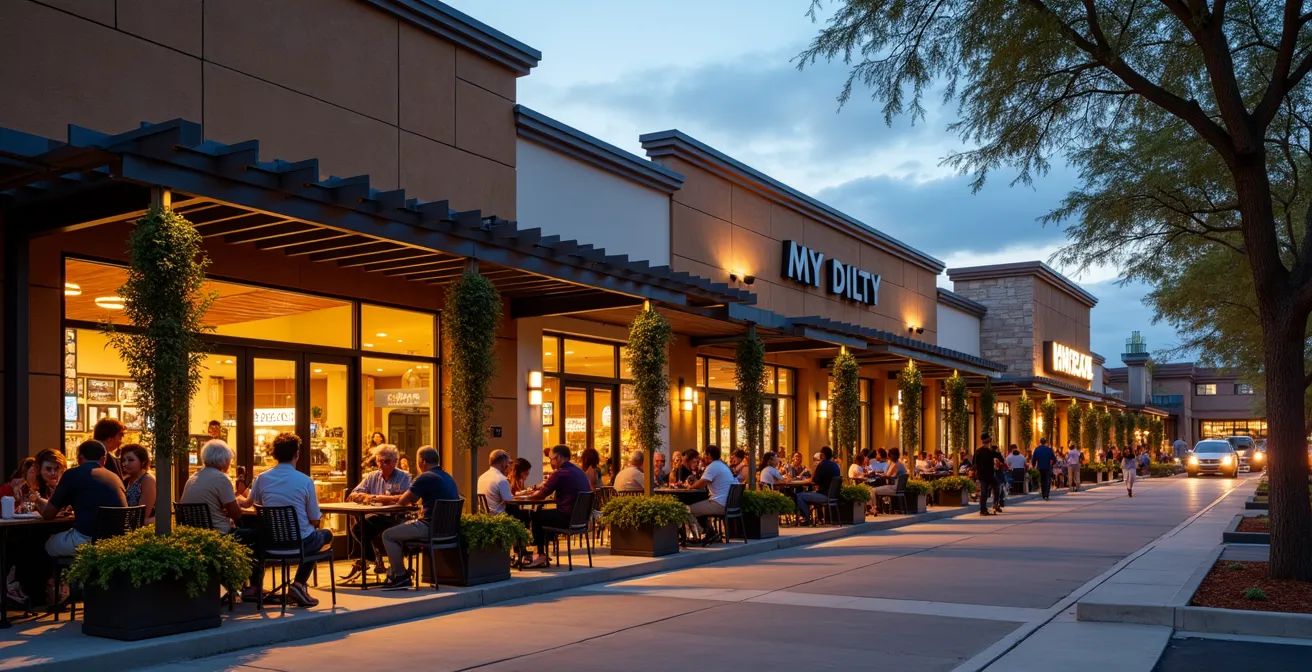
The return on these investments is tangible. As the BJ’s Wholesale Club’s small-format location in Warwick, Rhode Island, demonstrated, strategic facade and layout improvements focused on creating a localized shopping experience can lead to dramatic outperformance. The revitalized property beat state and nationwide foot traffic averages in four of the first five months of 2024. The key is to choose upgrades that provide the highest impact for the cost.
A careful analysis of the potential ROI for each type of upgrade allows an investor to deploy capital with precision, ensuring that every dollar spent on revitalization contributes directly to the bottom line.
| Upgrade Type | Investment Cost | Rent Impact | Payback Period |
|---|---|---|---|
| Pop-up ready infrastructure | $50-75/sq ft | +15-20% | 18-24 months |
| Outdoor dining areas | $30-40/sq ft | +10-15% | 24-30 months |
| Instagram-worthy murals/art | $10-20/sq ft | +5-8% | 12-18 months |
| Smart lighting systems | $15-25/sq ft | +8-12% | 20-26 months |
By investing in the “experience layer” of the property, you are not just improving aesthetics; you are manufacturing demand. You create a place where people want to be, which in turn allows you to curate a more desirable tenant mix and command premium rents.
How to Pivot Traditional Office Space into Medical or Lab Suites?
The visionary investor sees opportunity not just within a single asset class, but in the arbitrage between them. As the traditional office market faces headwinds from remote work, a parallel trend is creating immense demand: the growth of outpatient healthcare and life sciences. Converting underperforming B or C-class office buildings into high-demand medical office buildings (MOBs) or lab suites is one of the most lucrative “asset repurposing” plays in commercial real estate today.
This strategy is powerful because it solves two problems at once. It provides a new life for a struggling asset while tapping into a resilient, non-discretionary sector. Healthcare is largely recession-proof and not susceptible to e-commerce disruption. As a result, medical and lab tenants sign longer leases at premium rates, providing stable, long-term cash flow. The demand is significant; JLL reports that in 2024, medical and lab conversions now represent 14% of total commercial investment in alternative sectors.
However, this pivot is not a simple cosmetic renovation. It’s a complex and capital-intensive process that requires deep technical expertise. A standard office building is not equipped to handle the specific infrastructure needs of medical tenants. The due diligence for such a conversion is rigorous and must be approached with a detailed, engineering-focused mindset. Failing to account for these requirements can lead to catastrophic budget overruns and delays.
Your Action Plan: Critical Infrastructure Audit for Medical Conversion
- HVAC Assessment: Verify the system can be upgraded to provide a minimum of 15 air changes per hour and specialized filtration required for clinical environments.
- Plumbing & Gas Infrastructure: Map out paths for installing medical gas lines (oxygen, vacuum), specialized drainage, and hot water systems that meet health codes.
- Floor Load Capacity: Commission a structural engineering report to confirm the floors can support 100+ lbs/sq ft, necessary for heavy imaging equipment like MRI or CT scanners.
- Electrical Systems: Audit the building’s power capacity to ensure it can support dedicated circuits for sensitive equipment and robust backup power generation for life-safety systems.
- ADA & Zoning Compliance: Conduct a thorough review of accessibility routes, corridor widths, and bathroom specifications to ensure full ADA compliance, and research all special use permits and health department requirements.
By successfully navigating these technical hurdles, an investor can transform a liability into a high-performing cornerstone of a modern real estate portfolio, often creating a new traffic-driving anchor for adjacent retail assets.
How to Spot Gentrification Signs Before Property Prices Explode?
The most profound returns in real estate are made by anticipating demographic and cultural shifts before they are reflected in market prices. This is the art of spotting gentrification. For the urban ecosystem engineer, it’s not about displacing communities; it’s about identifying neighborhoods on the cusp of a renaissance and investing in commercial properties that will serve the incoming wave of residents and businesses. This requires moving beyond traditional real estate data and tapping into “alternative data” that signals change on the ground.
Waiting for the new artisanal coffee shop or yoga studio to open means you’re already late. The real signals appear 12 to 18 months earlier in municipal databases and social media trends. Savvy investors are now operating like data scientists, tracking leading indicators that predict a neighborhood’s trajectory. These signals, when analyzed collectively, paint a picture of imminent transformation long before it’s obvious to the mainstream market.
Case Study: Alternative Data in Brooklyn
In emerging neighborhoods across Brooklyn between 2023-2024, a clear pattern emerged. Advanced investors tracked a 30% increase in building permits filed for major renovations. This spike in renovation activity, a clear leading indicator of investment and confidence, preceded an 18-month jump in property values of between 25-40%. By tracking the permits, not the finished projects, these investors were able to acquire assets at a significant discount to their future value.
This data-driven approach involves a multi-pronged monitoring strategy. A sudden increase in business licenses for creative or food-service businesses, contrasted with a decline in industrial or auto-body permits, is a classic sign. Analyzing foot traffic data to spot a 20%+ increase in weekend vs. weekday traffic indicates the area is becoming a leisure destination. Similarly, a 40%+ increase in visitor dwell time suggests the neighborhood is evolving from a thoroughfare into a place where people want to spend time. Tracking the arrival of “experiential pioneers”—like independent cinemas, board game cafes, or even tool libraries—is another strong signal of a burgeoning creative class.
By identifying these early, data-driven gentrification indicators, the contrarian investor can position themselves to acquire assets at a low basis, poised to capture the explosive value appreciation that follows.
Key takeaways
- The most resilient retail assets are not just stores, but essential community hubs anchored by daily needs and amplified by an “experience layer.”
- Predictive data (foot traffic, building permits) is no longer a luxury but a fundamental tool for de-risking acquisitions and identifying value before the market does.
- The most visionary investors operate as “urban ecosystem engineers,” seeing the symbiotic potential between different asset classes like retail and office to create holistic, high-performing commercial districts.
Commercial Office Spaces: Is the “Death of the Office” Narrative a Myth?
The “Death of the Office” narrative is one of the most persistent myths in post-pandemic real estate. It’s also dangerously misleading. What we are witnessing is not a death, but a “Flight to Experience.” Boring, amenity-poor office buildings are indeed suffering, but high-quality, Class-A buildings with integrated amenities and a vibrant surrounding environment are commanding premium rents and high occupancy. For the retail investor, this is not a peripheral trend; it is a central opportunity.
A thriving office building is a built-in, high-spending customer base for adjacent retail. The synergy is undeniable. Office workers need places for lunch, coffee, after-work drinks, and quick errands. By investing in retail that serves a vibrant office hub, you are acquiring a captive audience. In fact, recent commercial real estate data shows that Class-A office buildings with integrated retail report 15% higher occupancy rates than those without, proving the value is a two-way street. The office drives traffic to the retail, and the retail makes the office a more desirable place to work.
It’s not ‘Death of Office’, it’s ‘Flight to Experience’ – boring, amenity-poor offices are suffering while Class-A buildings with integrated retail, fitness centers, and high-end F&B are commanding premium rents.
– Industry Analysis, Commercial Real Estate Investment Report 2024
This flight to quality is creating a stark bifurcation in the office market, with clear winners and losers. As the following data illustrates, the performance gap between amenity-rich buildings and their traditional counterparts is not marginal—it’s a chasm. Understanding this dynamic is crucial for any investor looking to build a truly integrated commercial ecosystem.
| Office Type | Occupancy Rate | Rent Premium | Tenant Retention |
|---|---|---|---|
| Amenity-Rich Class A | 92% | +25-30% | 85% |
| Standard Class A | 78% | Baseline | 65% |
| Class B Traditional | 65% | -15-20% | 45% |
| Suburban Hub-and-Spoke | 88% | +10-15% | 75% |
The contrarian play here is twofold: acquire retail assets that serve these winning, amenity-rich office hubs, or identify underperforming office assets adjacent to your retail and partner to upgrade them, thereby manufacturing your own customer base. The office is not dead; it has simply become a powerful new anchor for the retail experience economy.
To truly capitalize on the opportunities in today’s market, you must apply this holistic, ecosystem-level thinking to your next acquisition analysis, moving beyond the asset to see the entire urban fabric.