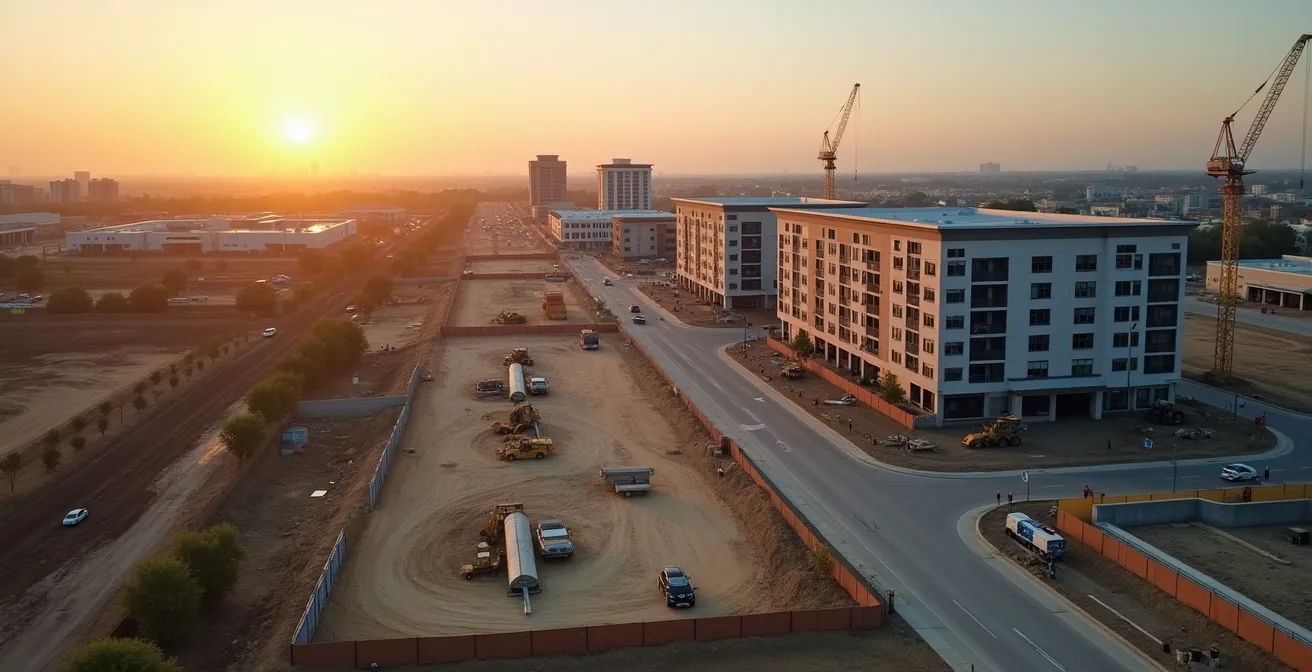
The greatest profits in land development come not from speculation, but from systematically manufacturing value and eliminating risk before a single shovel hits the ground.
- Value is created on paper first. Securing entitlements can increase land value by 300-400% before construction begins.
- Risk is controlled through strategy. Underestimating soft costs is a primary cause of failure, while accelerating permits is key to beating market cycles.
Recommendation: Shift your focus from finding the ‘perfect’ lot to creating the perfect project through strategic control over entitlements, financing, and design.
For experienced investors, the leap into land development is the final frontier of value creation. It’s a move from passively holding an asset to actively manufacturing one. Many see this field as a high-stakes gamble, defined by unforeseen risks and volatile market cycles. They’re not entirely wrong, but they are missing the point. The most successful developers don’t take risks; they methodically eliminate them. They treat land not as a lottery ticket, but as the raw material in a highly profitable production line.
The common advice to “do your due diligence” and “budget for contingencies” is table stakes. It’s the bare minimum. The real art and science of development lie in understanding the intangible levers that create massive value long before construction starts. It’s about mastering the arbitrage between a plan on paper and a physical, income-producing asset. This isn’t about waiting for appreciation; it’s about forcing it through superior strategy and execution.
This guide isn’t for beginners. It’s for you—the investor ready to become a creator. We will deconstruct the development cycle into its core profit drivers and risk factors. Forget the platitudes. We will focus on the operational tactics that separate the pros from the first-time failures, turning the high-risk, high-reward paradigm into a predictable, controllable process for building wealth.
This article will guide you through the critical phases and strategic decisions that define successful development projects. The following summary outlines the key areas we will dissect to give you a clear roadmap for navigating this complex but rewarding field.
Summary: A Developer’s Playbook for the High-Reward Cycle
- Why Getting Entitlements Approved Is the Biggest Value Driver in Development?
- How to Secure a Construction Loan When Banks Are Tightening Credit?
- Build-to-Sell vs. Build-to-Rent: Which Strategy Maximize Tax Benefits?
- The Budgeting Error That Bankrupts First-Time Developers
- How to Accelerate Permitting to Beat the Market Cycle Downturn?
- How to Spot “Unbuildable” Lots That Look Perfect on Paper?
- How to Force Appreciation Through Strategic Renovations Instead of Waiting?
- Investing in Raw Land: Strategic Asset or Dead Capital?
Why Getting Entitlements Approved Is the Biggest Value Driver in Development?
Before you ever think about concrete, steel, or construction crews, you must master the art of the entitlement process. This is where the most significant value in any development project is created. Entitlements are the legal permissions granted by a municipality to develop a property in a specific way. We’re talking about zoning changes, subdivisions, and site plan approvals. This is not just paperwork; it’s the act of transforming a piece of raw dirt with limited use into a fully-approved project with immense potential.
The value jump is staggering. Industry analysis confirms that land value can increase from $500,000 to $2 million after receiving entitlements, a 300-400% surge, all without a single physical improvement. This is the essence of “paper to project arbitrage.” You are manufacturing value by securing development rights. For example, a successful project in Las Vegas saw a property’s value triple simply by rezoning it from R-1 (one home per acre) to R-2 (up to 12 units per acre). This value wasn’t found in the ground; it was created through strategic navigation of municipal codes.
As a developer, your primary job is to be an expert in this process. You must identify land where the current zoning doesn’t reflect its highest and best use. Your profit is the delta between the land’s current value and its potential value once you’ve secured the rights to build something bigger, better, or different. This is the engine of your entire project.
Therefore, your first investment isn’t in materials, but in civil engineers, land-use attorneys, and architects who can build a bulletproof case for the local planning commission. This is the real foundation of your project.
How to Secure a Construction Loan When Banks Are Tightening Credit?
With valuable entitlements in hand, your paper asset is ready to become a physical one. But that requires capital—and lots of it. In a tight credit market, banks scrutinize every detail, and securing a construction loan becomes a major hurdle. Lenders are more risk-averse, and with construction loan rates currently ranging from 9.5% to 11.99%, the cost of capital is a significant line item on your pro-forma. Simply having a good idea isn’t enough; you need to present a de-risked project that a lender can’t refuse.
Your power in this negotiation comes from the work you did in the entitlement phase. Fully approved entitlements, a strong team, and a detailed budget demonstrate that you’ve eliminated major uncertainties. To further strengthen your position, you should also have a significant portion of your own equity in the deal and, if possible, pre-leasing commitments. A lender wants to see that you have skin in the game and that there’s already proven demand for your end product. You aren’t asking them to fund a dream; you’re asking them to finance a manufacturing process with a predictable outcome.

Understanding the different financing vehicles is also crucial. A standard construction-only loan is common, but bridge loans or even joint ventures with private equity partners can provide the necessary capital when traditional banks are hesitant. Your job is to structure the capital stack in a way that aligns with your project timeline and risk profile.
The following table outlines common loan structures for real estate development, helping you identify the right vehicle for your specific needs, from raw land acquisition to ground-up construction.
| Loan Type | Typical Rate Range | Term Length | Best For |
|---|---|---|---|
| Land Development | 5-15% | 12-24 months | Raw land development |
| Construction-Only | 9.5-11.99% | 12-36 months | Ground-up construction |
| Bridge Loans | 9.0%+ | 6-24 months | Quick capital needs |
| SBA 504 | 6.95% | 10-25 years | Owner-occupied projects |
Ultimately, a strong application package tells a story of control and predictability. When you can show a lender a clear path from loan disbursement to stabilization and repayment, you transform their decision from a risk assessment into a simple business transaction.
Build-to-Sell vs. Build-to-Rent: Which Strategy Maximize Tax Benefits?
Once your project is financed and underway, the next critical decision is the exit strategy. The two primary paths, build-to-sell (BTS) and build-to-rent (BTR), offer fundamentally different financial outcomes, especially when it comes to taxes. Your choice here will define your project’s profitability and your ability to build long-term wealth.
The build-to-sell strategy, often called “merchant building,” provides a quick, lump-sum profit. You build the asset, sell it at market price, and realize your capital gains. While this offers immediate liquidity, it also triggers an immediate and substantial tax event. The entire profit is subject to capital gains tax, which can significantly reduce your net return. This strategy is about capital velocity—getting your money out fast to redeploy into the next project.
The build-to-rent strategy is a long-term play focused on cash flow and wealth accumulation. By holding the asset, you benefit from rental income, appreciation, and, most importantly, powerful tax advantages. As one expert in land development strategy notes:
Build-to-rent projects allow for an aggressive depreciation schedule on a brand new asset, creating massive ‘paper losses’ in the first few years that can offset other active income
– Real Estate Development Expert, Land Development Strategy Analysis
This “paper loss” from depreciation is a developer’s best friend. It can shelter your rental income and potentially other income from taxes. Furthermore, a BTR strategy allows you to pull out your initial equity and profit tax-free through a cash-out refinance once the property is stabilized and leased up. This is the core of the popular BRRRR (Buy, Rehab, Rent, Refinance, Repeat) method, applied on a development scale. You retain a cash-flowing asset while getting your capital back to start the next project.
The optimal strategy depends on your capital needs and long-term goals. BTS is a transaction; BTR is the foundation of a real estate empire. Choose wisely.
The Budgeting Error That Bankrupts First-Time Developers
Every developer can estimate the cost of concrete, lumber, and labor—the “hard costs.” But it’s the “soft costs” that create budget overruns and bankrupt projects. These are the intangible, often underestimated expenses that are just as critical to the project’s success. Your pro-forma is a work of fiction until you’ve accurately accounted for every single one.
Soft costs include everything from architectural and engineering fees to permit fees, legal expenses, financing costs, and insurance. While hard costs are the physical building, soft costs are the price of bringing that building to life legally and logistically. According to industry data, soft costs typically account for 20-30% of the total development budget. Underestimating this by even a small margin can cascade into a catastrophic funding shortfall, forcing you to halt construction or seek expensive emergency capital.

The most dangerous soft cost is the contingency fund—or lack thereof. A 5% contingency on hard costs is standard, but experienced developers add a separate, often larger, contingency for soft costs. Why? Because soft costs are more volatile. A delay in permitting can extend your loan term, racking up thousands in additional interest. An unexpected legal challenge can lead to massive attorney fees. These are the risks that don’t show up in a materials quote.
A truly professional budget is a dynamic tool, not a static document. It must account for the timeline of each cost. For example, a large portion of your architectural and legal fees will be spent long before construction begins. If you budget based on the construction draw schedule, you’ll face a liquidity crisis early on. Map out every anticipated cost—from the first feasibility study to the final certificate of occupancy—on a detailed timeline.
Treat your soft cost budget with the same rigor as your structural engineering plans. One is designed to keep your building from collapsing physically; the other is designed to keep it from collapsing financially.
How to Accelerate Permitting to Beat the Market Cycle Downturn?
In development, time is not just money; it’s risk. The longer your project is stuck in the permitting phase, the more exposed you are to a market downturn, rising interest rates, and escalating construction costs. A project that pencils out perfectly today could be unprofitable in 12 months. Accelerating the permitting process is therefore a critical de-risking strategy. While the entitlement process typically requires 6 months to a year, there are levers you can pull to gain a crucial speed advantage.
The most effective strategy is to proactively manage the bureaucracy. This starts with project selection. Favoring “by-right” projects—those that conform to existing zoning and don’t require discretionary approvals like variances or rezoning—can shave months off your timeline. While the value creation might be less dramatic than a major rezoning, the reduction in risk and holding costs is often a worthy trade-off.
Next, you must treat the municipal planning department as a partner, not an adversary. Engage them early through pre-application meetings. Present your project professionally, listen to their feedback, and be prepared to make reasonable adjustments. A confrontational approach will only lead to delays. Building a reputation as a competent, cooperative developer will pay dividends on every future project in that jurisdiction.
Finally, invest in expertise. A local civil engineer with deep relationships at the planning department is invaluable. Even better, hiring a dedicated permit expediter can be one of the highest-ROI investments you make. These specialists know the people, the processes, and the common sticking points. They can navigate the system, submit concurrent permits (e.g., grading and foundation while architectural plans are being finalized), and ensure your application package is “bulletproof” from day one, minimizing the back-and-forth that kills timelines.
Your Action Plan: The Permit Acceleration Checklist
- Engage Departments Early: Schedule pre-application meetings with local planning staff to get upfront feedback and identify potential roadblocks before you submit.
- Prepare Bulletproof Applications: Submit a complete and flawless application package with all required studies, reports, and drawings to avoid deficiency letters and resubmission delays.
- Submit Permits Concurrently: Where possible, file for initial permits like grading and foundation while finalizing later-stage architectural plans to overlap timelines.
- Hire a Permit Expediter: Engage a local specialist with established relationships and a deep understanding of the municipal bureaucracy to navigate the process for you.
- Choose ‘By-Right’ Projects: Prioritize projects that comply with existing zoning to avoid lengthy and uncertain discretionary approval processes like variances or public hearings.
Don’t let your project’s fate rest in the hands of a bureaucratic timeline you can’t control. By being strategic, professional, and proactive, you can seize control of the clock and move your project forward while others are still waiting for a stamp of approval.
How to Spot “Unbuildable” Lots That Look Perfect on Paper?
Every developer has heard the horror stories: a perfectly located, reasonably priced parcel of land that turns out to be a financial black hole. These “unbuildable” lots often look flawless on paper but hide fatal flaws that can derail or bankrupt a project. Spotting these issues requires a level of due diligence that goes far beyond a simple title search and survey. It demands a forensic investigation into the ground beneath your feet and the regulations that govern it.
Some of the most common hidden dangers are geotechnical and environmental. A comprehensive geotechnical report is non-negotiable. It can reveal issues like expansive soils, a high water table, or the need for extensive rock excavation, any of which can add hundreds of thousands to your site work budget. Similarly, an environmental assessment can uncover soil contamination or protected wetlands that severely restrict or even prohibit development. For instance, a seemingly ideal site in Florida may be composed of wetlands requiring so much soil importation and earthwork that the project becomes financially unfeasible.
Beyond the physical land, you must investigate access and utilities. An easement that looks minor on a survey could prevent you from building your planned entrance. More critically, you need formal “Will-Serve” letters from all utility providers (water, sewer, electric, gas). A verbal confirmation is worthless. Without a written commitment confirming that they have the capacity to service your project, your land is effectively unbuildable. Many promising projects have died because the local sewer main was at capacity and the cost to upgrade it was prohibitive.
To avoid these pitfalls, your due diligence must be exhaustive. Consider this checklist as a starting point for your investigation:
- Geotechnical & Environmental: Order a full geotechnical report and a Phase I Environmental Site Assessment to check for soil stability, water table issues, contamination, and flood zones.
- Utility Capacity: Obtain formal “Will-Serve” letters from all utility providers (water, sewer, electric, gas) confirming they have the capacity and will connect to your project.
- Title & Covenants: Scrutinize the title report for any restrictive covenants, easements, or mineral rights that could limit your intended use or create access issues.
- Zoning & Variance: Verify that your intended use is explicitly allowed by current zoning. Never assume you can get a variance; base your initial numbers on what’s permitted by-right.
The best deal is often the one you walk away from. A thorough, almost paranoid, level of due diligence isn’t a cost center; it’s the cheapest insurance policy you can buy.
How to Force Appreciation Through Strategic Renovations Instead of Waiting?
In a build-to-rent model, value creation doesn’t stop once the certificate of occupancy is issued. While market appreciation is a welcome bonus, proactive developers manufacture their own appreciation by integrating strategic features and amenities that command higher rents and attract premium tenants. This is about moving beyond standard finishes and creating a product that stands out in the marketplace, allowing you to “force” appreciation rather than passively wait for it.
The key is to focus on renovations and additions with a clear and demonstrable return on investment. It’s not about luxury for luxury’s sake; it’s about quantifiable rental premiums. Adding in-demand amenities like state-of-the-art fitness centers, dedicated co-working spaces, or secure package rooms can often achieve a rental premium of 5-10% and dramatically reduce vacancy rates. These are no longer optional perks; they are essential components of a competitive modern rental property.
Even more impactful is the integration of “tech-forward” features. In today’s market, smart-home technology is a powerful differentiator. Simple, relatively low-cost additions can have an outsized impact on perceived value and rent. A keyless entry system not only adds convenience for tenants but also simplifies turnover for management. Smart thermostats offer energy savings that tenants are willing to pay a premium for. The data on these features is compelling.
This analysis of tech-forward amenities shows a clear path to boosting rental income. By focusing on features with a quick payback period, you can significantly increase your Net Operating Income (NOI) and, by extension, the total value of your property.
| Smart Feature | Installation Cost | Rental Premium | Payback Period |
|---|---|---|---|
| Keyless Entry System | $200/unit | $25/month | 8 months |
| Smart Thermostats | $300/unit | $30/month | 10 months |
| EV Charging Stations | $5,000/station | $50/month/spot | 8.3 years |
| High-Speed Internet Infrastructure | $500/unit | $40/month | 12.5 months |
Don’t just build a building; design a superior rental experience. By investing in the right amenities and technology, you can create a moat around your asset, justify higher rents, and directly manufacture a higher valuation.
Key Takeaways
- The greatest value in development is created on paper through entitlements, often before any construction begins.
- The biggest financial risk is underestimating soft costs, which can account for up to 30% of a project’s total budget.
- Build-to-rent strategies offer superior tax advantages through depreciation and tax-free refinancing, fostering long-term wealth over the quick profits of build-to-sell.
Investing in Raw Land: Strategic Asset or Dead Capital?
For the ultimate risk-taker, investing in raw, unentitled land represents the highest-potential reward. This is the very beginning of the value-creation chain, where a keen eye for future growth can lead to astronomical returns. However, without a clear strategy, raw land is just “dead capital”—an illiquid asset that generates no income while costing you money in taxes and carrying costs every single day. The difference between a strategic asset and a financial drain lies entirely in your plan and your expertise.
Holding raw land is a bet on the “path of progress.” A successful raw land investor must be an expert in regional economics, infrastructure plans, and demographic trends. You’re not just buying a piece of dirt; you’re buying a future location for a subdivision, a shopping center, or an industrial park. The goal is to acquire the land years before its development potential is obvious to the general market, and then either secure entitlements yourself or sell to a developer when the time is right.
This is a highly specialized field, and it’s not for the passive or inexperienced investor. As the experts at McNamara Ventures caution, this is a game for seasoned professionals:
Land development is a highly specialized asset class within real estate investing. I do not recommend investing in this asset class unless: 1) the Developer has many years’ experience processing tract maps and going through the entitlement process, and 3) the Investor is very comfortable taking a passive position in an illiquid asset
– McNamara Ventures, MV Properties Investment Analysis
To avoid the “dead capital” trap, you must have a plan to mitigate carrying costs during the holding period. This can include leasing the land for agricultural use, installing cell towers for monthly income, or even creating temporary RV or boat storage facilities. These small income streams can help offset property taxes and make the long wait for appreciation more palatable. This is a game of patience, deep market knowledge, and financial fortitude.
Raw land can be the source of generational wealth or a decade-long financial headache. It all comes down to whether you are speculating on progress or have a concrete, actionable plan to create it yourself.