
The greatest returns in raw land don’t come from passive appreciation, but from actively manufacturing equity by transforming the land’s potential on paper.
- Solving logistical problems like access or zoning restrictions unlocks disproportionate value.
- The entitlement process—getting approvals and permits—is the single biggest driver of value, de-risking the asset for future buyers.
Recommendation: Shift your focus from “buying and holding” to “buying and solving.” Identify a parcel’s core limitation and develop a clear strategy to eliminate it before you acquire it.
For many, the idea of investing in raw land conjures images of a hands-off, almost passive, wealth-building process. You buy a piece of the earth—a finite resource, after all—and simply wait for the inevitable march of progress to drive up its value. This “buy and hold” philosophy is the most common advice, suggesting that the primary skill is patience. But this perspective overlooks the most potent force in land investing: your own strategic intervention.
While passive appreciation can and does occur, it leaves returns entirely to chance and the whims of the market. The most sophisticated investors, those targeting massive multiples, don’t treat land as a static lottery ticket. They view it as dead capital, a blank canvas waiting for a specific, calculated plan to bring it to life. They understand that true wealth isn’t found by waiting for value to happen *to* the land, but by actively creating it *on* the land.
This shift in mindset is crucial. It changes the core question from “Where is the path of growth?” to “How can I force value onto this specific parcel?” This involves a more profound level of due diligence, one that goes beyond title searches and basic zoning checks. It’s about seeing problems not as deal-breakers, but as opportunities for arbitrage. A landlocked parcel, an unbuildable slope, or a complex zoning code are the very elements that suppress a property’s price, creating the opening for a strategic investor to unlock its hidden potential.
This guide will deconstruct that strategic process. We will explore how to identify and mitigate the hidden costs that erode returns, how to differentiate a true opportunity from a money pit, and most importantly, how to systematically manufacture equity through subdivision and the entitlement process. It’s time to move beyond patience and embrace strategy.
This article provides a detailed roadmap for the strategic land investor. We will navigate the critical risks, identify the most powerful value-creation levers, and outline the high-level thinking required to turn dirt into a high-performing asset.
Summary: A Strategist’s Guide to Raw Land Investment
- Why Property Taxes Can Drain Your Return on Vacant Land Investments?
- How to Spot “Unbuildable” Lots That Look Perfect on Paper?
- Infill Lots vs. Rural Acreage: Which Appreciates Faster?
- The Easement Nightmare: Buying Landlocked Property You Cannot Access
- How to Split One Lot into Three to Triple Your Equity Instantly?
- Why Getting Entitlements Approved Is the Biggest Value Driver in Development?
- Why Selling a Classic Car Takes 6 Months Longer Than Selling Stocks?
- Land Development Projects: Navigating the High-Risk, High-Reward Cycle
Why Property Taxes Can Drain Your Return on Vacant Land Investments?
Unlike income-producing properties where rent covers expenses, raw land is a pure cost center until the day it’s sold. The most relentless of these costs is property tax. While often lower than for developed parcels, these annual payments are a constant drain on your capital, a negative-compounding force that directly erodes your future returns. A 1-2% annual property tax may seem minor, but over a decade-long hold, it can consume 10-20% of your initial investment before you’ve even accounted for a sales commission. This “tax drag” is the silent killer of many passive land investment strategies.
The strategic investor, however, views this liability through a different lens. First, they recognize that a seller’s inability to keep up with even minor tax payments is a powerful signal of distress. As one analysis points out, investors can often acquire land at deep discounts from owners burdened by back taxes, as this signals both financial strain and a lack of emotional attachment to the property. An owner struggling with a few hundred dollars in taxes is an owner who is ready to negotiate.
Second, the active investor doesn’t passively accept the tax bill. They actively work to minimize it. This involves researching specific land use programs, such as agricultural exemptions, that can dramatically lower the assessed value. A simple grazing lease or beekeeping agreement might be all it takes to reclassify the land and slash the annual holding costs, preserving capital and extending the runway for your investment thesis to play out.
Your Action Plan: Mitigating Property Tax Burden
- Research agricultural tax exemptions and land use programs in your state that can significantly reduce your tax assessment.
- Consider temporary uses like grazing leases or beekeeping agreements to qualify for agricultural tax rates.
- Document all land improvements and maintenance costs for potential tax deductions.
- Review your property assessment annually and file appeals if the valuation exceeds market comparables.
- Calculate your break-even point by comparing annual tax costs against projected appreciation rates.
This proactive management of holding costs is a foundational element of strategic land investment. It transforms a passive liability into an active part of your acquisition and management strategy, directly boosting your final return on investment.
How to Spot “Unbuildable” Lots That Look Perfect on Paper?
The allure of a cheap parcel of land can be intoxicating. It looks perfect on a satellite map—flat, accessible, and nestled in a promising area. Yet, this is often where the novice investor makes their most costly mistake. A significant portion of “bargain” lots are cheap for a reason: they are, for all practical purposes, unbuildable. The value of raw land is almost entirely tied to its potential for future use, and if that use is restricted or impossible, the land is effectively dead capital.
Identifying these hidden traps requires a level of due diligence that goes far beyond a casual glance at a plat map. It involves a deep dive into zoning codes, topographical surveys, and environmental constraints. A property might be zoned for agriculture only, with no path to residential rezoning. It might sit on a floodplain, contain protected wetlands, or have slopes too steep for a conventional foundation. These are not minor details; they are fundamental barriers to value creation.
To visualize this process, imagine an analyst’s desk layered with maps and reports. This is the work required to vet a property thoroughly.

This image captures the essence of deep due diligence. The strategic investor must become an expert at interpreting these layers of information—zoning, access, utilities, topography, and environmental flags. It’s crucial to understand which of these “unbuildable” characteristics are permanent and which are “curably unbuildable,” meaning they can be resolved with time, money, and expertise. A zoning issue might be solvable through a variance application, or a lack of utilities might be fixed by extending a nearby line. The key is to price the cost of the cure into your acquisition offer.
The following table outlines the critical factors that differentiate a viable building lot from a potential financial disaster. Understanding these distinctions is the first line of defense against buying a worthless piece of earth.
| Factor | Buildable Land | Unbuildable Land | Curably Unbuildable |
|---|---|---|---|
| Zoning | Matches intended use | Restrictive zoning | Can be rezoned with effort |
| Access | Road frontage or easement | Landlocked | Easement negotiable |
| Utilities | Available nearby | No infrastructure | Can be extended |
| Topography | Suitable slopes | Steep/unsuitable | Can be graded |
| Environmental | Clean assessment | Wetlands/contamination | Minor issues fixable |
Infill Lots vs. Rural Acreage: Which Appreciates Faster?
The debate between investing in urban infill lots versus expansive rural acreage is a classic one. Infill lots—vacant parcels in already developed areas—benefit from existing infrastructure, proven demand, and proximity to amenities. They represent a seemingly safer, more predictable path to appreciation. Rural acreage, on the other hand, offers the potential for larger-scale projects and a different kind of buyer appeal, one rooted in the desire for space, privacy, and a connection to nature.
Conventional wisdom often favors infill lots, assuming they will appreciate faster due to scarcity and location. While they are certainly a strong asset class, this view can be shortsighted. The demand for land is not monolithic. We are in a market where there’s a nearly 2:1 demand-to-supply ratio for land, with a significant backlog of new homes waiting for available lots. This pressure exists in both urban and rural markets, creating distinct opportunities in each.
The demand for rural land, in particular, is often underestimated. As land specialist Daniel Apke of BiggerPockets notes, there’s a robust market for these parcels. His insight highlights a specific and growing buyer pool that is actively seeking out larger lots away from city centers.
There’s actually a demand in rural America for these rural lots. There’s so many people out there looking for five acres, 10 acres, 20 acres.
– Daniel Apke, BiggerPockets On The Market Podcast
Ultimately, the question of which appreciates faster is the wrong one. The right question is: “Where can I most effectively manufacture equity?” For an infill lot, this might mean navigating complex city permits to get a multi-family unit approved. For rural acreage, it could involve subdividing a large tract into several desirable 5- or 10-acre “ranchettes.” Both strategies can yield immense returns. The key is not the location itself, but the alignment of the property’s potential with your specific value-add strategy.
The Easement Nightmare: Buying Landlocked Property You Cannot Access
Of all the potential pitfalls in raw land investing, few are as absolute as buying a landlocked parcel. This is a property with no legal access from a public road. You may own it, but you, and any future buyer, have no legal right to cross a neighbor’s property to reach it. It is an island, and without a bridge, its value is decimated. These properties often appear as incredible bargains, but they are a trap for the unwary investor who fails to verify legal access.
A title report may show clean ownership, and a map may show a simple path, but unless a formal, recorded easement exists, that path is meaningless. An informal agreement with a neighbor can be revoked at any time, especially once they realize the leverage they hold over your property’s value. A landlocked property is a prime example of a logistical problem that, if left unsolved, renders the asset almost worthless.
The aerial view below illustrates this classic scenario: a desirable parcel completely surrounded by other properties, with no clear path for entry or exit.
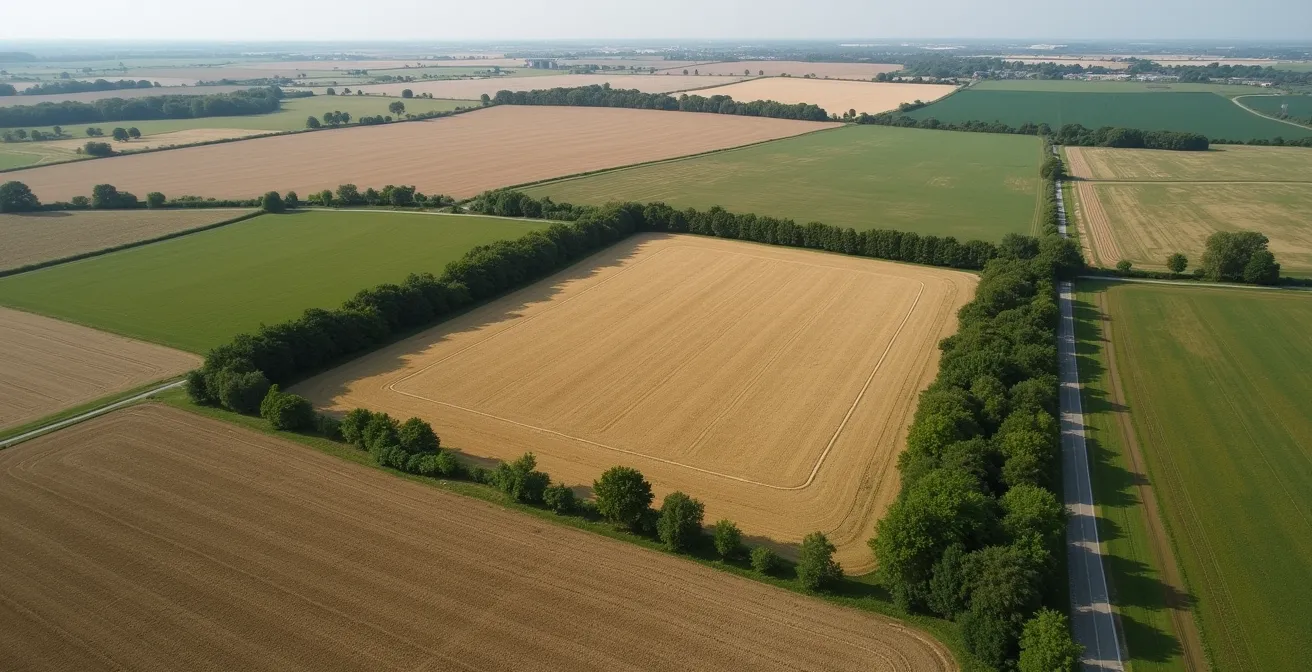
However, for the strategic investor, “landlocked” isn’t an immediate disqualifier; it’s a puzzle to be solved. This is a core tenet of manufacturing equity. If you can secure legal access, you can unlock the property’s full value at a fraction of its market price. This involves a delicate process of negotiation with adjacent landowners, deep legal research into historical access rights (prescriptive easements), or even exploring a legal action to claim an “easement by necessity.” The key is to have a clear, costed plan to solve the access problem *before* you close on the purchase.
Resolving an access issue is a high-level play that requires expertise and patience. Below are the key steps an investor would take to transform a landlocked liability into a valuable asset.
- Research existing easements on neighboring properties that might provide legal access rights.
- Negotiate with adjacent landowners for an access easement, using equity offers or lump-sum payments.
- Investigate prescriptive easement rights if historical use patterns can be proven.
- Consider purchasing a small adjoining strip of land to create your own access corridor.
- Consult with a land use attorney to explore legal options like an “easement by necessity.”
- Secure all agreements in a legally recorded document before finalizing the property purchase.
How to Split One Lot into Three to Triple Your Equity Instantly?
One of the most direct ways to manufacture equity in raw land is through subdivision. The principle is simple: the sum of the parts is often worth far more than the whole. A single 30-acre parcel might sell for $150,000, but if you can legally split it into three 10-acre lots, each of those might sell for $75,000, grossing $225,000. This $75,000 lift isn’t passive appreciation; it’s equity you created through a strategic, administrative process.
This strategy hinges on understanding the local municipality’s subdivision regulations. Most jurisdictions differentiate between “minor” and “major” subdivisions. A minor subdivision, typically creating only two or three lots, is a far simpler, faster, and cheaper process. It often requires little more than a survey and administrative approval. A major subdivision, creating four or more lots, triggers a much more rigorous, expensive, and time-consuming process involving public hearings, environmental impact studies, and requirements to build roads and other infrastructure.
The strategic investor often targets properties where a minor subdivision is feasible. This offers the greatest return for the least amount of brain damage and capital outlay. It’s a focused play to unlock value quickly. Simply taking raw land through the approval process for a lot split can add a significant premium, as you are selling a de-risked project to a buyer who wants a shovel-ready opportunity. Evidence suggests that just entitling a site can increase its value by 30% or more compared to its raw state.
The following table breaks down the critical differences between these two paths, highlighting why a minor subdivision is such an attractive strategy for manufacturing equity with speed.
| Aspect | Minor Subdivision (2-3 lots) | Major Subdivision (4+ lots) |
|---|---|---|
| Approval Time | 2-6 months | 12-24+ months |
| Infrastructure Requirements | Minimal | Roads, utilities required |
| Professional Costs | $5,000-$15,000 | $25,000-$100,000+ |
| Environmental Review | Basic | Comprehensive EIS |
| Public Hearings | Usually none | Multiple required |
Why Getting Entitlements Approved Is the Biggest Value Driver in Development?
If subdivision is about multiplying value, entitlements are about crystallizing it. The entitlement process is the formal procedure of securing legal permission from a government agency to develop a property in a certain way. This includes obtaining zoning changes, variances, site plan approvals, and, ultimately, building permits. It is, without question, the most significant value-add activity in all of land investing. It is the bridge between raw potential and tangible, financeable value.
Raw land is an abstraction to a bank or a home builder. It’s a risky proposition with countless unknowns. An entitled property, however, is a defined project. It has a stamp of approval from the city, a clear set of plans, and a quantifiable path to completion. This act of de-risking the asset is what creates an enormous value premium. A builder isn’t just buying dirt; they’re buying certainty and speed. As land developer James Dainard explains, this certainty has a direct financial benefit for the next person in the value chain.
Permits are ready to issue, which then a builder can get better financing on.
– James Dainard, BiggerPockets On The Market Podcast
This is the essence of “entitlement arbitrage.” A land strategist can buy a parcel for $100,000, spend $20,000 and six months navigating the city’s approval process, and create a “permit-ready” lot that is now worth $180,000 to a builder. The $60,000 profit wasn’t from market appreciation; it was manufactured by turning bureaucratic hurdles into a defined, valuable asset. Each milestone in the entitlement process adds a quantifiable layer of value, from a simple rezoning to a fully approved site plan.
The process requires a skilled team—a land use attorney, a civil engineer—and a deep understanding of the local political landscape. You must frame your project as a win for the municipality, one that aligns with their master plan and grows their tax base. It is a high-stakes game of patience and precision, but it is the single most powerful lever for creating outsized returns.
Why Selling a Classic Car Takes 6 Months Longer Than Selling Stocks?
The title of this section uses a metaphor to highlight a fundamental truth about raw land: it is an illiquid asset. Unlike a stock, which can be sold in seconds, selling a piece of land can be a slow, arduous process that takes months, or even years. There is no centralized exchange, buyers are scarce, and each transaction is a unique, high-friction negotiation. This lack of liquidity is a primary risk and a major reason many investors avoid the asset class entirely.
This slow sales cycle means your capital is tied up. It is the direct trade-off for the potential of high returns and the long-term security that comes from owning a finite resource. The market has shown that raw land tends to appreciate in value over time due to its limited supply and increasing demand, but realizing that appreciation requires finding a buyer. You cannot simply decide to “cash out” on a Tuesday afternoon. Your money is locked in the dirt until a deal is closed.
A strategic investor accepts this reality and plans for it. They do not invest capital they might need in the short term. More importantly, they don’t passively wait for a buyer to appear. They actively and aggressively market their property across multiple channels to maximize exposure and shorten the sales cycle. The typical land seller might just list on the MLS with a realtor and wait. The strategic seller understands that different buyers live on different platforms.
They execute a multi-pronged marketing strategy, often forgoing a traditional agent to save on commission and control the narrative. This can involve listing simultaneously on platforms like Facebook Marketplace to catch local buyers, Craigslist for bargain hunters, and Zillow’s “For Sale by Owner” section for more traditional real estate searchers. By casting a wider net, they increase the velocity of their marketing, which is the only control they have over the velocity of their capital.
Key Takeaways
- Raw land’s primary value comes not from passive waiting but from active, strategic intervention to “manufacture” equity.
- The biggest risks—property taxes, unbuildable conditions, and lack of access—are also the greatest opportunities for value creation if you can solve them.
- The entitlement and subdivision processes are the most powerful levers for forcing appreciation, turning bureaucratic processes into tangible financial gains.
Land Development Projects: Navigating the High-Risk, High-Reward Cycle
Investing in raw land with the intent to develop or entitle is the pinnacle of the high-risk, high-reward spectrum in real estate. It offers the potential for life-changing returns, allowing investors to generate significant cash without ever dealing with tenants or toilets. The strategy is to buy at a deep discount, force appreciation through strategic improvements on paper, and then sell to a developer or end-user for a handsome profit. It is a game of turning information and approvals into wealth.
This entire process is predicated on the idea that with urban sprawl and population growth, the underlying scarcity of land will always be a tailwind. As development expands, strategically located parcels become increasingly valuable. However, this long-term trend is punctuated by economic cycles, financing hurdles, and bureaucratic nightmares. The path is fraught with peril, from entitlement risk (the city denying your plans) to market absorption risk (not being able to sell your finished lots at the projected price).
Successfully navigating this cycle requires more than just a good eye for property; it demands rigorous risk management. A strategic developer anticipates these challenges and builds mitigation plans from day one. They secure financing commitments early, engage a professional A-team of lawyers and engineers to de-risk the entitlement process, and use fixed-price contracts to protect against construction cost overruns. This discipline separates the successful developer from the one who loses their shirt.
The matrix below outlines the primary risks in a land development project and the corresponding professional-grade strategies used to manage them. It serves as a blueprint for thinking through the entire lifecycle of a project before a single dollar is spent.
| Risk Type | Mitigation Strategy | Cost Impact |
|---|---|---|
| Financing Risk | Secure commitments early, multiple funding sources | 3-5% of project cost |
| Entitlement Risk | Pre-application meetings, professional team | 5-10% of land value |
| Construction Cost Risk | Fixed-price contracts, contingency reserves | 10-15% contingency needed |
| Market Absorption Risk | Phased development, pre-sales strategy | Varies by market cycle |
By shifting from a passive holder to an active strategist, you change the very nature of the investment. You are no longer waiting for the future; you are building it. The first step in this journey is to assess your own resources and risk tolerance to determine which of these strategies aligns with your long-term financial goals.