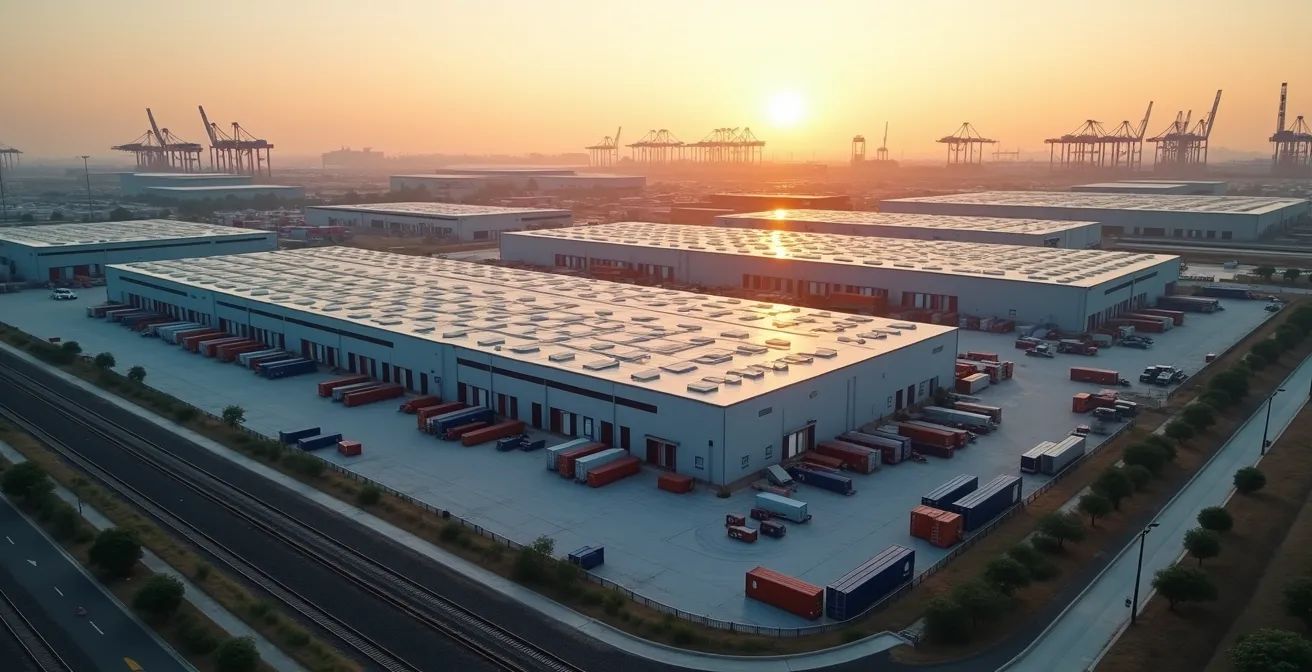
Superior returns in logistics real estate are no longer driven by location alone, but by mastering the structural value drivers at critical supply chain nodes.
- Intermodal velocity—the speed of transfer between rail, ports, and trucking—is a primary value multiplier, often doubling an asset’s strategic importance.
- Entitlement arbitrage, or securing flexible, future-proof zoning pre-development, represents the largest single source of value uplift in a logistics project.
Recommendation: Focus investment theses on assets that solve tangible operational bottlenecks and possess development rights that anticipate future technological and market shifts.
For institutional investors, the industrial logistics sector has transcended its traditional classification as a simple real estate asset class. It now represents a direct investment in the foundational infrastructure of global commerce. While the common wisdom points to e-commerce growth and the importance of location, this view is dangerously incomplete. The most sophisticated investors understand that the market is bifurcating sharply between generic, replaceable “sheds” and irreplaceable, high-velocity “nodes.” The former faces commoditization, while the latter commands premium rents and valuation multiples.
The core challenge is no longer just finding land near a highway. It is about identifying and controlling the structural choke points within the supply chain. True value is not merely found; it is created. This involves a deeper analysis of intermodal connectivity, operational efficiency designed into the asset itself, and the strategic navigation of regulatory landscapes. The most significant alpha is generated by understanding how a facility accelerates the flow of goods, not just how it stores them. This requires a shift in perspective from a real estate mindset to a supply chain infrastructure mindset.
This analysis moves beyond the platitudes to dissect the key structural levers that drive outsized returns. We will explore how proximity to rail and ports acts as a value multiplier, why internal capabilities like cross-docking attract the most valuable tenants, and how to navigate the critical path of development from zoning to completion. The goal is to equip investors with a macro-economic framework for identifying and developing the next generation of critical logistics assets—the true backbone of modern trade.
To provide a structured approach for institutional-grade analysis, this report details the key pillars of value creation in the modern logistics landscape. The following sections break down the specific strategies that separate commodity assets from cornerstone investments.
Summary: Investing in the Core Arteries of Global Commerce
- Why Proximity to Rail and Ports Doubles the Value of Logistics Centers?
- How Cross-Docking Capabilities Attract High-Volume Logistics Tenants?
- Greenfield Development vs. Brownfield Redevelopment: Which Is Faster to Market?
- The Zoning Mistake That Stalls Logistics Projects for 3 Years
- How to Structure Tenant Improvement Allowances to Secure 10-Year Leases?
- How to Identify “Path of Progress” Locations for Industrial Hubs?
- Why Getting Entitlements Approved Is the Biggest Value Driver in Development?
- Industrial Warehousing Assets: Why Last-Mile Logistics Is the New Gold Rush?
Why Proximity to Rail and Ports Doubles the Value of Logistics Centers?
The adage “location, location, location” is an oversimplification in the context of institutional logistics investment. The more precise metric is intermodal velocity—the speed and efficiency with which goods can be transferred between shipping containers, rail cars, and trucks. A logistics center that is merely near a port or rail line is a commodity. An asset with direct, low-friction access that minimizes drayage costs and transit times is a strategic infrastructure node. This distinction is the primary driver of the significant value premium associated with true intermodal locations.
Rail is a critical component of this equation. As noted by Cargoson Market Analysis, rail moves a staggering 40% of U.S. long-distance freight, dominating the transport of bulk goods and intermodal containers. This reliance on rail is expanding globally. The China-Europe Railway, for instance, saw its freight train services explode from 1,702 to over 17,000 annually, a testament to the strategic necessity of integrated rail-port networks. For an investor, this means a site’s value is a direct function of its integration into these macro-level trade corridors.
The economic impact is quantifiable. The entire ecosystem supporting these movements is massive; research on rail logistics infrastructure shows the global rail logistics market was valued at $416.8 billion in 2024 and is projected to grow steadily. Facilities that can effectively tap into this flow by reducing transfer friction command higher rents and attract tenants with longer-term horizons, as their own business models are structurally dependent on this efficiency. Therefore, due diligence must extend beyond a simple map to a detailed analysis of rail spurs, port turnaround times, and drayage capacity.
Ultimately, a logistics center’s long-term value is directly proportional to its ability to function as a high-capacity, low-friction conduit between major modes of transport, making it an indispensable link in the global supply chain.
How Cross-Docking Capabilities Attract High-Volume Logistics Tenants?
While external connectivity is paramount, the internal design of a logistics facility is a powerful, yet often overlooked, driver of tenant demand and rental premiums. Among the most valuable design features is cross-docking capability. A cross-docking facility is not designed for storage but for sorting and immediate redistribution. Inbound trucks unload goods on one side of the building, which are then sorted and loaded directly onto outbound trucks on the other side, often in under an hour. This creates immense operational density and throughput.
This model is exceptionally attractive to high-volume tenants—such as major retailers, parcel carriers, and grocery distributors—whose business models are predicated on speed and minimizing inventory holding costs. By virtually eliminating the storage phase, cross-docking drastically reduces handling, labor requirements, and the need for large inventory footprints. The financial benefits are significant. For high-volume tenants, these operational efficiencies translate directly into a willingness to pay premium rents for facilities that enable them. A building with cross-docking capabilities is not just a warehouse; it is a critical piece of their distribution machinery.
The performance improvements for tenants are well-documented and provide a clear investment case for developing these specialized facilities. An analysis of cross-docking operations highlights the quantifiable gains that attract premium users.
| Benefit Category | Performance Improvement | Impact on Tenants |
|---|---|---|
| Service Levels | 37.9% improvement | Faster customer fulfillment |
| Transportation Costs | 32.4% reduction | Lower operational expenses |
| Distribution Efficiency | 29% improvement | Streamlined operations |
| Space Utilization | 20% increase | More efficient facility use |
For institutional investors, financing the development of cross-dock facilities is a strategic play on the core needs of the most resilient and fastest-growing logistics operators. It is an investment in operational velocity, a feature that commodity warehouses cannot replicate.
Greenfield Development vs. Brownfield Redevelopment: Which Is Faster to Market?
The decision between developing on a pristine greenfield site versus redeveloping an existing brownfield industrial location is a critical strategic choice with profound implications for project timelines and returns. The conventional wisdom—that greenfield is faster and simpler—is often incorrect. While greenfield development avoids the complexities of demolition and potential environmental remediation, it frequently faces a much longer and more unpredictable entitlement and zoning process, especially in areas with limited existing industrial infrastructure.
Brownfield redevelopment, conversely, often benefits from being located in areas already zoned for industrial use. Municipalities are typically more receptive to upgrading an existing industrial site than to introducing industrial use into a new area. This can dramatically shorten the entitlement timeline. Furthermore, brownfield sites often have existing infrastructure—roads, water, sewer, and power—that can accelerate the construction phase by 6 to 12 months compared to a raw greenfield parcel. These sites also tend to be closer to established labor pools, a critical factor for tenants.
The choice is not merely about construction speed but about total time to market, which includes the lengthy and uncertain pre-construction phase. A brownfield project with a 9-month environmental cleanup and a 6-month entitlement process is often faster to market than a greenfield project that spends three years battling for zoning approval.

This visual comparison underscores the two distinct paths. The left represents the blank slate of a greenfield, with its potential for design freedom but also its uncertainty. The right shows the transformation of a brownfield site, leveraging existing infrastructure to create a modern asset. To make an informed decision, investors must conduct a rigorous analysis of the factors driving speed to market.
Action Plan: Evaluating Development Paths for Speed to Market
- Regulatory Predictability: Audit the zoning codes and recent council decisions for both target greenfield and brownfield sites. Prioritize brownfield locations in established industrial zones with clear redevelopment precedents.
- Infrastructure Readiness: Commission an engineering report to inventory existing utility capacity (power, water, fiber) and road access for the brownfield site. Quantify the cost and timeline savings versus a greenfield extension.
- Capital Stack Analysis: Engage with lenders specializing in ESG to model the potential interest rate reduction and favorable terms available for a brownfield redevelopment project, which often qualifies for green financing.
- Labor Pool Mapping: Use GIS data to map commute times and workforce density for both site types. A brownfield site’s proximity to labor is a key leasing advantage to present to future tenants.
- Future-Use Zoning: During entitlement negotiations for either site type, proactively secure rights for multiple uses (e.g., logistics, data centers, light manufacturing) to build in long-term optionality and maximize asset value.
Therefore, a seemingly complex brownfield project can often represent a faster and more de-risked path to generating cash flow, provided the investor has the expertise to manage its technical challenges.
The Zoning Mistake That Stalls Logistics Projects for 3 Years
In logistics development, the most significant and costly delays are rarely caused by construction issues; they are rooted in a failure to strategically manage the zoning and entitlement process. As highlighted in a report from CBRE Investment Management, “structural factors are limiting new logistics construction, notably the rise of NIMBYism (‘Not In My Back Yard’) and zoning challenges.” The single greatest mistake an investor can make is underestimating this phase, treating it as a procedural hurdle rather than a central pillar of value creation.
A common but devastating oversight is failing to secure flexible, forward-looking zoning from the outset. Many developers pursue a narrow “industrial-only” classification that meets their immediate needs. However, this severely limits the asset’s future adaptability. The most costly error is not accounting for future technological requirements. A property without the zoning rights for drone operations, extensive EV fleet charging infrastructure, or the power-density required for automated systems will be functionally obsolete within a decade. Securing these rights upfront is a form of entitlement arbitrage that creates immense, defensible value.
Another critical failure is a reactive approach to community opposition. NIMBYism can stall a project for years. The most successful developers preempt these challenges by proactively integrating community benefits into their initial applications. This includes creating green-space buffers, funding local infrastructure improvements, and making firm local hiring commitments. This transforms the developer from an antagonist into a community partner, smoothing the path to approval. Restrictive single-use zoning creates a rigid asset, whereas negotiating for flexible-use zoning that permits logistics alongside light manufacturing or data centers provides invaluable optionality as market demands shift over the asset’s lifecycle.
Ultimately, a project’s timeline and profitability are often determined before a single shovel hits the ground. A proactive, strategic, and forward-thinking approach to zoning is not just risk mitigation; it is one of the most powerful tools for value creation in an investor’s arsenal.
How to Structure Tenant Improvement Allowances to Secure 10-Year Leases?
In the competition for high-quality, long-term tenants, the Tenant Improvement (TI) allowance has evolved from a simple concession into a powerful strategic tool. Historically a fund for paint and partitions, the modern TI allowance is increasingly a co-investment in the tenant’s operational technology. To secure 10-year leases from top-tier logistics companies, landlords must structure TI packages that enable the deployment of automation, robotics, and advanced sorting systems. This aligns the landlord’s capital with the tenant’s long-term strategic goals, embedding the tenant in the facility and making a move prohibitively complex and expensive.
The imperative for this shift is data-driven. According to the Materials Handling Institute’s 2023 survey, an overwhelming 90% of logistics companies expect to spend at least $1 million on digital supply chain technologies. This represents a massive increase from pre-pandemic levels and signals a permanent technological shift. A landlord who offers a generic TI allowance for cosmetic upgrades is missing the point. The winning strategy is to offer a structured allowance that can be applied to mission-critical infrastructure: enhanced power grids, reinforced flooring for robotic systems, and extensive data connectivity.
This approach transforms the landlord-tenant relationship from a transactional one to a partnership. By financing the backbone of a tenant’s technological operations, the landlord creates immense stickiness. The tenant’s investment in software, training, and processes specific to that facility makes the location an integral part of their network. This deep integration is the strongest possible incentive for a long-term lease renewal, creating a stable, predictable cash flow stream for the investor.

As this image of a modern, automated facility suggests, the value is in the systems the building supports. The TI allowance should be viewed as seed capital for this ecosystem, ensuring the asset remains at the forefront of operational efficiency.
Instead of being a lease-up cost, a technology-focused TI allowance becomes a strategic investment in long-term asset value and tenant retention, yielding returns far beyond the initial outlay.
How to Identify “Path of Progress” Locations for Industrial Hubs?
Identifying the next high-growth industrial hub requires moving beyond trailing indicators like current rent growth and occupancy. Leading investors engage in “path of progress” analytics, a forward-looking discipline that identifies locations poised for structural growth before it becomes obvious to the broader market. This involves tracking second-order indicators of future demand, such as public infrastructure spending, demographic shifts, and educational investment.
Recent history provides a clear playbook. The rise of logistics hubs like Charleston and Savannah was not an accident; it was a direct result of massive public investment in port deepening to accommodate Post-Panamax ships. Similarly, the growth of El Paso as a cross-border logistics hub was catalyzed by the USMCA trade agreement and the near-shoring trend. In each case, the “path of progress” was visible years in advance to those analyzing macro-level capital flows and policy shifts, not just real estate data. Florida’s rapid population growth, for example, elevated Jacksonville, Orlando, and Tampa into critical logistics corridors before rent growth fully reflected the new demand.
To identify the next El Paso or Savannah, investors must become adept at synthesizing disparate data sets. The key is to look for converging indicators that signal a region’s capacity to support a larger industrial ecosystem. The following factors are among the most reliable leading indicators:
- Municipal Infrastructure Investments: Monitoring city budgets for major upgrades to water, sewer, and, most importantly, the electrical grid. A planned substation upgrade is a strong signal of future industrial capacity.
- Educational Infrastructure: Identifying cities that are investing in logistics-focused vocational programs and technical colleges. A growing pool of skilled labor is a powerful magnet for large-scale operators.
- Energy Development: Tracking the development of renewable energy sources and grid modernization projects. Access to cheap, reliable, and increasingly green power is a significant competitive advantage.
- Intermodal Expansion: Following public and private investment in the expansion of inland ports, rail spurs, and intermodal terminals. These projects are the physical manifestation of a new trade route being formed.
- Population and Commuting Patterns: Analyzing residential building permits and anonymized mobile data to spot emerging population centers and new commuting corridors, which are precursors to last-mile logistics demand.
By focusing on the underlying drivers of growth rather than its lagging symptoms, investors can systematically identify and capitalize on the “path of progress,” securing assets in locations destined to become the next essential nodes in the supply chain network.
Why Getting Entitlements Approved Is the Biggest Value Driver in Development?
In logistics real estate development, the greatest creation of value often occurs not during construction, but during the pre-development phase: the process of securing entitlements. An entitlement is the legal right, granted by a government entity, to develop a property in a specific manner. Successfully navigating this process to obtain robust, flexible zoning for an undeveloped or underdeveloped parcel is the single largest driver of value uplift, a concept known as entitlement arbitrage.
The opportunity is rooted in a fundamental market inefficiency: the vast majority of existing logistics stock is functionally obsolete. A CBRE Investment Management analysis reveals that 82% of U.S. logistics assets were built before 2000, with an average warehouse age exceeding 43 years. These older facilities lack the clear heights, truck court depths, power capacity, and ESG features required by modern tenants. A parcel of land without entitlements is just a plot. That same parcel, once entitled for a modern, 1-million-square-foot logistics center, has seen its value multiply, often before any construction begins. The value has been created by removing the regulatory risk.
This value is amplified when entitlements include forward-thinking provisions. As noted by CBRE Investment Management, “Buildings with renewable energy sources onsite, such as rooftop solar panels, provide a more sustainable solution—a rooftop installation can power up to 80% of a facility’s energy use.” Securing the rights for such installations during the initial entitlement process adds another layer of value, appealing to ESG-mandated institutional capital and reducing future operational costs for tenants. The developer who secures these rights is not just building a warehouse; they are creating a highly desirable, future-proofed infrastructure asset.
Therefore, for institutional investors, partnering with or building development teams with a core competency in entitlement strategy is the most direct path to generating alpha in the logistics sector. The tangible construction is merely the final execution of a value thesis that was proven on paper first.
Key Takeaways
- Strategic location is defined by intermodal velocity—the speed of transfer between transport modes—not just proximity.
- Facility design, particularly cross-docking, creates operational density that attracts premium, high-volume tenants and justifies higher rents.
- Entitlement arbitrage, securing flexible and future-proofed zoning, is the single largest value driver in a logistics development project.
Industrial Warehousing Assets: Why Last-Mile Logistics Is the New Gold Rush?
The explosive growth of e-commerce has fundamentally reshaped the logistics landscape, creating a modern-day “gold rush” for a specific asset type: the last-mile delivery station. These smaller, urban infill facilities are the critical final link between a regional distribution center and the consumer’s doorstep. Their value is not derived from massive scale, but from their strategic proximity to dense population centers. This sub-sector is experiencing the most intense demand and rent growth within the industrial asset class.
The demand is structural and accelerating. Global Growth Insights market analysis shows that e-commerce-related warehousing is projected to constitute 32% of total warehouse demand by 2026, a significant increase from an already high base. This relentless consumer demand for faster delivery times places an enormous premium on facilities that can enable one-hour or same-day service. As a result, the barriers to entry are immense. Land in dense urban areas is scarce and expensive, and zoning for industrial use is often met with fierce community opposition, making existing or entitled last-mile facilities exceptionally valuable.
This gold rush is not limited to standard e-commerce. A significant and rapidly growing sub-sector is cold-chain logistics, driven by online grocery delivery and the distribution needs of biopharmaceuticals. The global warehousing industry is projected to reach nearly $668 billion by 2035, with cold storage becoming an increasingly vital component. These facilities have even higher barriers to entry due to their technical complexity and cost, creating a niche where investors can achieve superior, risk-adjusted returns. For institutional capital, the last-mile sector represents a compelling opportunity to invest in a market with non-discretionary demand, high barriers to entry, and strong pricing power.
For investors with the strategic foresight to navigate these complexities, the last-mile logistics sector offers one of the most compelling growth opportunities in modern real estate. The next step is to translate this macro understanding into a specific investment thesis, identifying the assets and sub-markets that are best positioned to capture this demand.
Frequently Asked Questions on Investing in Logistics Centers
What is the most costly zoning oversight for logistics projects?
Failing to secure flexible zoning that allows for future technological needs like drone operations, EV charging infrastructure, and data center-level power connectivity can severely limit property value and tenant appeal. A restrictive permit today creates an obsolete asset tomorrow.
How can developers avoid community opposition delays?
Proactively integrate community benefits into initial zoning applications, including noise buffers, public park access, and local hiring commitments. This shifts the narrative from an adversarial one to a partnership, which can preempt NIMBY opposition and accelerate approvals.
Why is single-use industrial zoning problematic?
Restrictive industrial-only zoning limits future adaptability as market demands evolve. Negotiating for flexible zoning that permits alternative uses, such as light manufacturing or data centers, creates valuable optionality and future-proofs the investment against shifts in the economy.