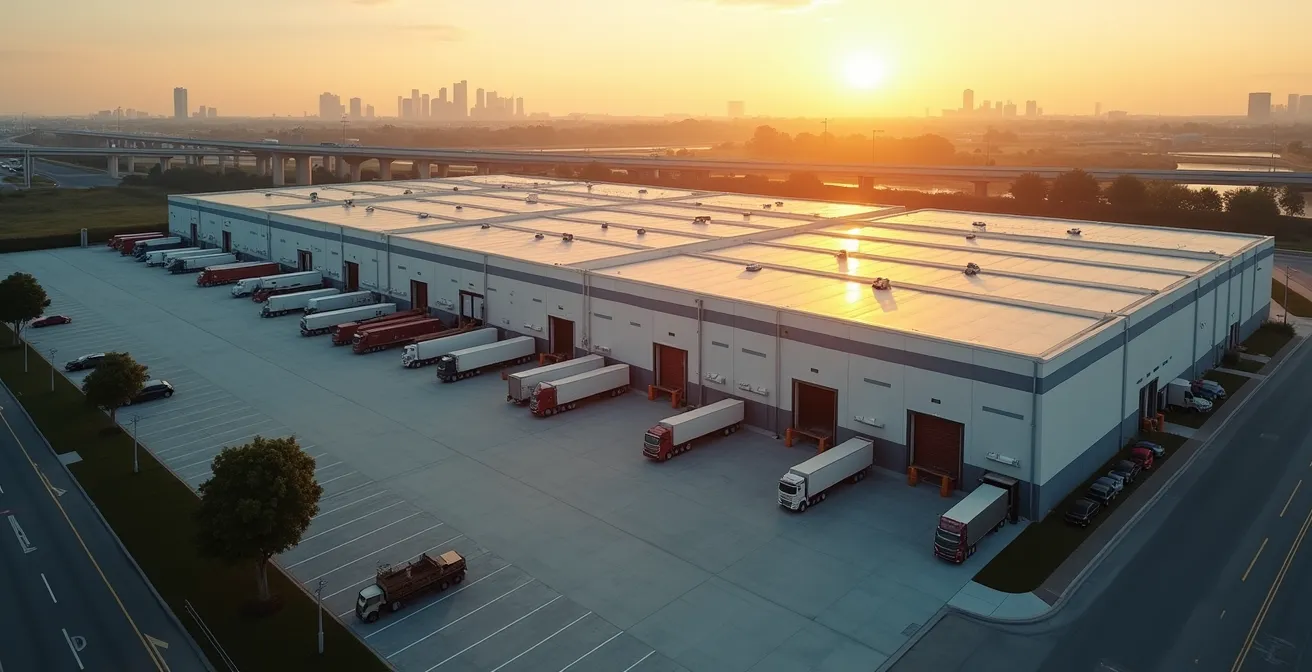
For investors pivoting from residential real estate, the true value of an industrial warehouse is no longer just its location, but its physical capacity to support high-velocity, automated logistics.
- The most critical metrics have shifted from simple square footage to clear height (for vertical automation), power capacity (for robotics), and multimodal access (for supply chain resilience).
- Older assets without these features face rapid “asset obsolescence,” making them high-risk investments despite prime locations.
Recommendation: Shift your due diligence focus from a residential mindset to an infrastructural one. Prioritize assets that are “automation-ready” to secure long-term, high-value tenants in the e-commerce economy.
For investors accustomed to the rhythms of residential real estate, the siren song of the industrial sector—particularly last-mile logistics—is growing louder. The narrative is simple: e-commerce is booming, and it needs space. While this is true, many new investors are entering this “gold rush” with the wrong map. They evaluate warehouses using familiar metrics like price per square foot and proximity to population centers, treating them like oversized apartment buildings. This approach overlooks the seismic shift happening inside these structures.
The modern logistics center is not a passive storage box; it is a high-velocity hub of robotics, complex machinery, and data-driven inventory management. The value of these assets is no longer defined merely by their footprint, but by their volume, power, and connectivity. Tenants are not just leasing space; they are leasing operational capacity. An older warehouse in a great location can be functionally useless—and therefore a value trap—if it cannot support the infrastructure of modern logistics.
But if the old rules no longer apply, what are the new ones? The key lies in deciphering the physical and infrastructural attributes that legacy investors often miss. This article moves beyond the generic advice of “buy near cities” to provide a strategic framework for evaluating industrial warehousing assets. We will deconstruct the metrics that truly matter, from the non-negotiable importance of clear height to the hidden risks of soil contamination, equipping you with the expertise to identify properties built for the future, not the past.
This guide will navigate you through the critical evaluation points of modern industrial assets. The following sections break down the specific features that differentiate a future-proof investment from a potential liability, giving you a clear roadmap for capitalizing on the logistics boom.
Summary: A Strategic Guide to Industrial Real Estate Investment
- Why Clear Height Is the Most Important Metric for Modern Warehouse Tenants?
- How to Identify “Path of Progress” Locations for Industrial Hubs?
- Cold Storage vs. General Warehousing: Which Offers Higher Barriers to Entry?
- The Soil Contamination Risk That Bankrupts Industrial Property Buyers
- When to Upgrade Power Systems to Attract Robotics-Heavy Tenants?
- Why Proximity to Rail and Ports Doubles the Value of Logistics Centers?
- Coastal Cities vs. Midwest: Which Markets Offer Better Appreciation Potential?
- Investing in Logistics Centers: The Backbone of Global Trade Flows
Why Clear Height Is the Most Important Metric for Modern Warehouse Tenants?
For investors transitioning from residential, the instinct is to value a property based on its floor area or square footage. In modern industrial warehousing, this is a critical mistake. The most valuable metric is vertical: clear height, the distance from the floor to the lowest overhead obstruction. Today’s logistics are driven by speed and density, which requires stacking goods vertically in complex racking systems, often managed by Automated Storage and Retrieval Systems (ASRS). A low ceiling physically caps a tenant’s operational efficiency.
The difference is not incremental. A facility with a 45-foot clear height can offer 40% more leasable cubic space than an older building with a 32-foot height, even with the same square footage. This concept, which we can call Cubic Velocity, is what sophisticated tenants are willing to pay a premium for. They are not just storing goods; they are moving them through a three-dimensional system. As a result, industrial properties with 36-foot or greater clear heights often command 15-25% premium rents over their lower-ceiling counterparts. Modern Class A facilities now consider a 32-foot clear height the absolute minimum, with many new builds pushing 40 feet or more to accommodate multi-level mezzanines and advanced robotics.
Therefore, when evaluating a potential acquisition, your first question shouldn’t be “How many square feet?” but “What is the clear height?”. A building with a lower clear height may be a candidate for what is known as infrastructural arbitrage—raising the roof—but this is a significant capital expenditure that must be factored into the purchase price. For most, targeting assets that already meet modern height requirements is the safer, more profitable strategy.
How to Identify “Path of Progress” Locations for Industrial Hubs?
“Location, location, location” remains a truism, but the definition of a prime industrial location has evolved. The “path of progress” for logistics is no longer just about following suburban population growth. It’s about anticipating the convergence of infrastructure, labor availability, and transportation arteries. For an investor, this means using a data-driven approach to identify emerging logistical corridors before they become saturated and overpriced.
A key driver in this location analysis is the rising cost of labor. With the average hourly wage for warehouse workers nearing $24.00, tenants are aggressively pursuing automation to control operational expenditures. This creates a demand for facilities in locations that not only have access to a skilled workforce for maintaining these systems but also offer favorable development conditions for building the highly specialized structures automation requires. These locations are often found at the intersection of major highways, near intermodal rail hubs, and within a reasonable distance of both urban centers and regional distribution networks.
Visualizing these factors helps in identifying the next high-growth areas. Investors should look for regions with planned infrastructure upgrades, zoning that favors industrial development, and proximity to major transportation routes that are not yet at full capacity.

As the image suggests, the ideal location is a node within a complex network. By analyzing traffic flow, land availability, and municipal development plans, an investor can identify zones where “logistical gravity” is increasing. Acquiring land or assets in these pre-boom areas is how fortunes are made, positioning you to meet the demand that will inevitably follow the path of progress.
Cold Storage vs. General Warehousing: Which Offers Higher Barriers to Entry?
Within the industrial asset class, not all warehouses are created equal. For investors seeking higher returns and stickier tenants, the cold storage sub-sector presents a compelling, albeit more complex, opportunity. The primary appeal of cold storage lies in its significantly higher barriers to entry compared to general, or “dry,” warehousing. These barriers are both financial and operational, creating a protective moat around existing investments.
The most immediate barrier is cost. Industry analysis reveals that it costs 2 to 3 times more to build a refrigerated warehouse than an equivalent unrefrigerated one. This is due to the need for advanced insulation, robust power infrastructure to run cooling systems 24/7, and specialized construction techniques to prevent issues like frost heave. This high upfront capital cost naturally limits the number of new developers and speculators entering the market, keeping supply in check.
Operationally, the stakes are also higher. The specialized nature of handling temperature-sensitive goods, from pharmaceuticals to fresh food, leads to market consolidation. A few major players, such as Lineage and Americold, dominate the North American market, controlling a significant share of the refrigerated space. Furthermore, tenants often invest millions in their own proprietary refrigeration systems within the facility, creating exceptionally high switching costs. This results in longer lease terms and a much lower risk of vacancy compared to the more commoditized dry-warehousing sector. For an investor, this translates to more predictable, long-term cash flow from a highly defensive asset class.
The Soil Contamination Risk That Bankrupts Industrial Property Buyers
For investors accustomed to residential properties, environmental due diligence might mean little more than a check for mold or radon. In the industrial world, it is a high-stakes process where a single oversight can lead to financial ruin. The most significant of these “hidden” risks is soil and groundwater contamination. Many prime industrial sites have a long history of prior uses—manufacturing, chemical storage, or fuel depots—that may have left behind a legacy of hazardous materials like solvents, petroleum products, or heavy metals.
Discovering contamination post-acquisition can trigger a chain of catastrophic costs, from multi-million-dollar cleanup liabilities mandated by environmental agencies to the complete inability to secure financing or tenants. It can render a seemingly valuable asset worthless overnight. This is why a Phase I Environmental Site Assessment (ESA) is not an optional extra; it is the most critical piece of due diligence for any industrial property purchase. This investigation researches the historical use of the site to identify potential contamination risks before you commit.
However, risk is also a source of opportunity. As noted by industry experts, the challenge of outdated facilities is a major theme in the sector. In their “Industrial Real Estate Outlook Q3 2025,” the Clarion Partners Research Team highlights this issue:
Product obsolescence has become a significant challenge in the sector; legacy warehouses often lack the infrastructure to support advanced automation
– Clarion Partners Research Team, Industrial Real Estate Outlook Q3 2025
This concept of asset obsolescence extends to environmental status. A savvy investor can pursue a “remediation-as-value-add” strategy, purchasing a contaminated site in a prime location at a steep discount, managing the cleanup process, and creating a highly valuable, modern asset. This requires deep expertise and capital but offers outsized returns. To navigate this complex area, a systematic approach is essential.
Your Environmental Due Diligence Checklist for Industrial Properties
- Conduct a Phase I Environmental Site Assessment (ESA) to identify recognized environmental conditions from historical or current use.
- Investigate potential vapor intrusion risks, where volatile organic compounds (VOCs) in the soil can enter the building’s air.
- Review historical Sanborn maps, city directories, and aerial photos to identify specific past uses and potential contaminants (e.g., dry cleaners, gas stations).
- Consider environmental insurance or liability buyout contracts as a tool to transfer and mitigate potential cleanup cost risks.
- Evaluate a remediation-as-value-add strategy by pricing in cleanup costs for contaminated but well-located sites.
When to Upgrade Power Systems to Attract Robotics-Heavy Tenants?
If clear height is the skeleton of a modern warehouse, its power system is the central nervous system. An underpowered building is a dead building in the age of automation. Traditional warehouses required little more than electricity for lighting and basic equipment. Today’s logistics facilities are power-hungry ecosystems of conveyor belts, sorting machines, autonomous mobile robots (AMRs), and ASRS systems. Forgetting to vet a property’s electrical capacity is a mistake that can render it obsolete.
The trend is undeniable. The global market for warehouse automation is exploding, with some projections showing it will reach a staggering $57.09 billion by 2030. Tenants are not just “considering” robotics; they are building their entire operational models around them. This requires heavy-duty power infrastructure: 3-phase power, high amperage (often 2,000-4,000 amps or more), and transformers capable of handling massive, fluctuating loads. A building that cannot provide this is immediately disqualified by the most desirable, high-credit tenants.
This creates a clear decision point for investors: When is it worth upgrading? The answer lies in infrastructural arbitrage. If you can acquire an older, underpowered building in a prime location at a discount, a capital investment in a power system upgrade can unlock immense value. This transforms the asset into an “automation-ready footprint,” allowing you to attract top-tier tenants and command premium rents that far exceed the cost of the upgrade.

The image above highlights the complexity and scale of the required infrastructure. Before acquiring any industrial asset, your due diligence must include a thorough assessment by an electrical engineer. Determine the existing capacity, the cost to upgrade, and the timeline for working with the local utility provider. In today’s market, having an “automation-ready” power system is not a luxury; it is the price of admission.
Why Proximity to Rail and Ports Doubles the Value of Logistics Centers?
While last-mile delivery to consumers gets much of the attention, the “first” and “middle” miles of the supply chain—moving goods from ports and manufacturing centers to regional hubs—are where immense value is created or destroyed. For an industrial warehouse, direct access to multiple modes of transport is the ultimate value multiplier. An asset with proximity to major ports and intermodal rail facilities experiences a powerful force of logistical gravity, pulling in high-value tenants who are desperate to reduce transportation costs and improve supply chain resilience.
A warehouse that is only accessible by truck is vulnerable to road congestion, driver shortages, and volatile fuel prices. In contrast, a rail-served facility allows tenants to move bulk goods over long distances more cheaply and with a lower carbon footprint—a growing priority for ESG-conscious corporations. A facility adjacent to a major seaport allows for the rapid “drayage” of containers, slashing the time and cost of getting imported goods into the distribution network. A true “multi-modal” hub, with access to port, rail, and highway, is the holy grail, offering maximum flexibility and commanding the highest rents.
This value premium is not theoretical; it is quantifiable and significant. The following table, based on industry analysis, breaks down how infrastructure access directly impacts the value of a logistics asset.
| Location Type | Value Premium | Key Advantages |
|---|---|---|
| Port Adjacent (under 5 miles) | +40-60% | Direct container access, FTZ benefits |
| Rail-Served | +25-35% | ESG premium, lower transport costs |
| Highway Only | Baseline | Truck access only |
| Multi-Modal Hub | +50-75% | Maximum flexibility, tenant appeal |
As an investor, this data provides a clear directive. When evaluating a property, look beyond its four walls to the transportation infrastructure that feeds it. The presence of a rail spur or its location within a designated Foreign-Trade Zone (FTZ) near a port are not minor details; they are fundamental drivers of long-term value and appreciation.
Coastal Cities vs. Midwest: Which Markets Offer Better Appreciation Potential?
For decades, the logic of industrial real estate was simple: invest in dense coastal markets like Los Angeles, New Jersey, and Miami. These port-adjacent hubs were the undeniable epicenters of global trade. While they remain critical, the investment landscape is becoming more nuanced. High barriers to entry, fierce competition, and record-high pricing in these Tier 1 cities are forcing savvy investors to look inland for better appreciation potential.
The new frontier for industrial growth is the Midwest. Cities like Kansas City, Indianapolis, Columbus, and Chicago are emerging as powerful “inland ports.” These markets offer a hybrid strategy: they provide significantly lower entry costs than their coastal counterparts while maintaining direct, efficient access to the global supply chain via extensive intermodal rail networks. A container can be offloaded at the Port of Los Angeles and be on a train to Kansas City within hours, bypassing the congested and expensive coastal warehousing market entirely.
This trend is being accelerated by the reshoring and onshoring of manufacturing. As companies bring production back to North America, they are increasingly choosing to co-locate their manufacturing facilities with their distribution centers in these central, business-friendly Midwestern hubs. This creates a sticky, built-in demand for logistics space that is less prevalent in coastal cities, which are primarily focused on import/export flows. An investment in an Indianapolis warehouse, for example, taps into both national distribution networks and a burgeoning local manufacturing economy.
This doesn’t mean coastal markets are poor investments; they offer stable, low-risk returns from highly established demand. However, for investors seeking higher growth and appreciation, the Midwest presents a more compelling risk/reward profile. By getting in ahead of the institutional capital that is now flowing into these inland ports, investors can capture significant value as these regions mature into the next generation of critical logistics hubs.
Key Takeaways
- The value of a modern warehouse lies in its cubic volume, not just its square footage. Clear height is the primary metric for enabling the automation and vertical racking that tenants require.
- An “automation-ready footprint” is defined by heavy-duty power infrastructure. Assessing a building’s amperage and 3-phase power capacity is as crucial as checking its roof.
- True value multipliers are found outside the building. Direct access to port, rail, and highway (multi-modal access) can increase an asset’s value by over 50% by creating supply chain resilience.
Investing in Logistics Centers: The Backbone of Global Trade Flows
The transition from residential to industrial real estate is more than a change in asset class; it’s a fundamental shift in investment philosophy. Success is no longer about aesthetics and amenities, but about raw operational efficiency and infrastructural capacity. As we’ve seen, the metrics that define a valuable logistics center—clear height, power, multimodal access, and environmental integrity—are the physical enablers of the modern e-commerce economy.
The demand for these specialized facilities is not slowing down. On the contrary, analysts estimate that projected e-commerce growth will require 250-350 million square feet of new U.S. logistics space by 2030. This staggering figure represents an enormous and sustained opportunity for investors who know where to look and what to look for. The “gold rush” is real, but the gold is not on the surface; it is buried in the technical specifications of the buildings themselves.
By adopting an infrastructure-first mindset, you move from being a passive landlord to a strategic partner in the global supply chain. You are providing the critical backbone that allows goods to flow from factory to port to front door. This is a resilient, non-discretionary demand that will persist through economic cycles, offering a powerful alternative to the more volatile residential market.
To successfully pivot into this sector, your next step is to integrate these new metrics into your due diligence. Begin evaluating potential acquisitions not just on their location and price, but on their ability to serve the high-velocity, automated tenants of today and tomorrow. This is how you stake your claim in the new industrial gold rush.